
Chronic Pain: Try Physical Therapy First and Where Class IV Laser Fits
By Dr. John Mishock, PT, DPT, DC
Chronic pain can slowly change the way a person lives. The painful knee that once bothered you on stairs starts limiting your walks. The shoulder that hurt occasionally begins interfering with sleep. Back pain makes you think twice about exercising, golfing, working in the yard, or playing with your grandchildren.
For many patients, the next step becomes medication, injections, imaging, or eventually a surgical consultation. Those treatments certainly have a place. But for many common musculoskeletal conditions, there is another logical place to start:
Try physical therapy first.
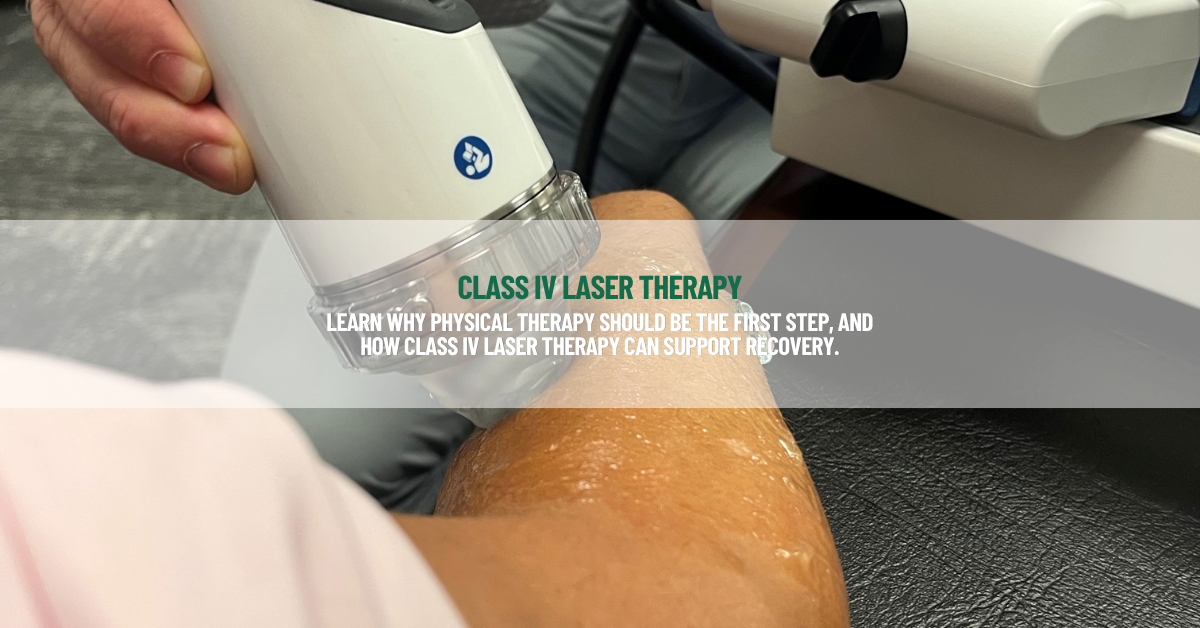
At Mishock Physical Therapy, one technology we can incorporate into a comprehensive rehabilitation program is Class IV laser therapy, a form of high-powered therapeutic laser treatment designed to deliver photobiomodulation to painful or injured tissues. The key word, however, is incorporate. Laser therapy should not replace exercise, movement, strengthening, or addressing the reason the problem developed in the first place.
Chronic Pain Is More Than an Injured Body Part
When pain persists for months or years, the problem can become more complicated than simply identifying damaged tissue.
Arthritis, tendon degeneration, spinal changes, previous injuries, muscle weakness, loss of mobility, inflammation, sleep, stress, activity level, and changes in how the nervous system processes pain can all contribute. That is why simply treating the painful spot often isn’t enough.
A physical therapist evaluates how the entire system is functioning. We look at mobility, strength, movement patterns, balance, joint loading, functional limitations, and the specific activities a patient wants to regain. For chronic low back pain, for example, clinical practice guidelines published by George and colleagues in the Journal of Orthopaedic & Sports Physical Therapy in November 2021 emphasize nonpharmacologic treatment, including exercise and other physical therapy interventions.
That philosophy is important: reduce pain, restore function, and progressively rebuild the body’s capacity to tolerate activity.
Where Does Class IV Laser Therapy Fit?
Class IV laser therapy allows relatively high amounts of light energy to be delivered to tissue. The treatment falls within the broader field of photobiomodulation.
Proposed effects include modification of cellular signaling, inflammatory processes, circulation, and pain processing. The practical goal is straightforward: decrease pain enough to help a patient move and rehabilitate more effectively. And there is meaningful research behind high-intensity laser therapy.
A 2023 systematic review and meta-analysis by Arroyo-Fernández and colleagues in the Journal of Clinical Medicine evaluated 48 randomized clinical trials involving high-intensity laser therapy for musculoskeletal disorders. The researchers found improvements in both pain and function. However, they appropriately classified the certainty of the evidence as low for pain and moderate for function. Low back pain has also been studied specifically. A 2023 systematic review and meta-analysis published in Lasers in Medical Science found
that high-intensity laser therapy produced statistically significant improvements in pain and measures of disability compared with control treatments.
Knee osteoarthritis is another promising area. Khalilizad, Hosseinzade, and Marzban Abbas Abadi reported in the Journal of Lasers in Medical Sciences in August 2024 that both high-intensity and low-level laser combined with exercise improved pain and function, with high-intensity laser plus exercise demonstrating favorable results at eight weeks.
But Is Laser a Magic Wand? No.
This is where patients deserve transparency. A major 2026 systematic review and network meta-analysis by de la Barra Ortiz, Parizotto, and Liebano in Lasers in Medical Science found that high-intensity laser produced greater pain reduction than low-level laser in some comparisons, particularly when combined with exercise or other physical therapy treatments.
But the authors also found that many improvements were modest and that the overall certainty of evidence was very low because studies differed considerably in conditions, treatment dosages, and methodology. That is an important finding. The research does not support abandoning rehabilitation and simply putting a laser over something that hurts.
It supports using laser, when appropriate, as one component of a multimodal rehabilitation program. That is exactly how I believe advanced technology should be used.
Reduce Pain, Then Build Capacity
Imagine someone with chronic knee arthritis. Laser therapy may help decrease pain and irritability. But if that person still has weak quadriceps, poor hip strength, limited mobility, poor balance, and reduced cardiovascular conditioning, we haven’t solved the entire problem. We have simply turned down the alarm. Now we need to strengthen the building. The same principle applies to chronic back pain, shoulder problems, tendinopathies, and many other musculoskeletal conditions.
Our objective isn’t simply: “How do we make it hurt less today?” It is: “How do we help you move better, become stronger, tolerate more activity, and return to the things you want to do?” Class IV laser gives us another tool to potentially help accomplish that. Exercise gives us another. Manual therapy gives us another.
Education, progressive loading, balance training, mobility work, and lifestyle modification may all become pieces of the same treatment strategy.
Try PT First
Chronic pain should not automatically mean chronic medication, repeated injections, or surgery.
There are situations where those treatments are absolutely appropriate, and certain symptoms require medical evaluation rather than conservative treatment alone. But for many musculoskeletal problems, physical therapy provides an opportunity to address pain and the underlying loss of function before progressing to more invasive options.
My philosophy is simple: Use the technology. Follow the science. Treat the entire person. And build the body back up. Class IV laser may help us control pain and create a better window for rehabilitation. But ultimately, the goal isn’t simply to feel better while lying on a treatment table. The goal is to decrease pain, improve function, and get your life back.
We can help!
If pain is limiting you from doing the activities you enjoy, give Mishock Physical Therapy a call: locations in Gilbertsville (610-327-2600), Skippack (610-584-1400), Phoenixville (610-933-3371), Boyertown (610- 845-5000), Limerick (484-948-2800) at www.mishockpt.com or request your appointment by clicking here.
Dr. Mishock is one of only a few clinicians with doctorate-level degrees in both physical therapy and chiropractic in the state of Pennsylvania. He has also authored two books; “Fundamental Training Principles: Essential Knowledge for Building the Elite Athlete”, “The Rubber Arm; Using Science to Increase Pitch Control, Improve Velocity, and Prevent Elbow and Shoulder Injury” both can be bought on Amazon or train2playsports.com.