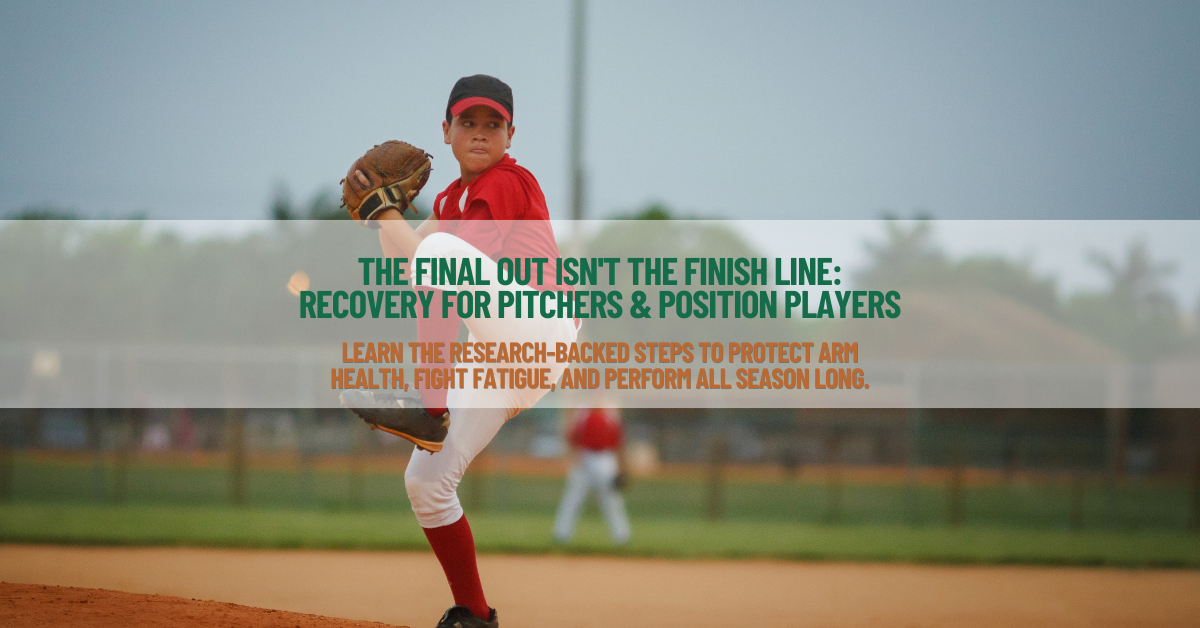
The Final Out Is Not the Finish Line: Evidence-Based Recovery for Pitchers and Position Players
How to Protect Arm Health and Sustain Performance Through Travel Baseball Season
By Dr. John Mishock, PT, DPT, DC
Travel baseball places unusual demands on young athletes. Players may compete in several games over a weekend, throw repeatedly in extreme heat, sit through long delays, eat irregularly, sleep in hotels, and return to the field the following morning. The player who manages recovery effectively does more than reduce soreness. He protects his lower body, shoulders, and elbows, restores whole-body performance, and improves his chances of remaining healthy throughout the season. Recovery should not be viewed as a collection of gadgets or isolated arm exercises. It is a coordinated process involving workload management, nutrition, hydration, sleep, mobility, resistance exercise, and honest communication about pain and fatigue.
Fatigue Is a Major Warning Sign
One of the most important findings in baseball research involves pitching while fatigued. Adolescent pitchers who regularly pitched despite arm fatigue had approximately 36 times the odds of being in the group that required shoulder or elbow surgery compared with pitchers who did not routinely throw through fatigue (Olsen et al., American Journal of Sports Medicine, 2006). Fatigue and injury occur not only with the arm but with any other body part as well. That statistic should command the attention of every player, parent and coach. Fatigue is not simply a temporary decline in performance. It may alter velocity, accuracy, joint position, muscular function, throwing mechanics, and deliberate body language. After a pitching appearance, measurable reductions have been reported in shoulder flexion, internal rotation, and adduction strength (Mullaney et al., American Journal of Sports Medicine, 2005; Erickson et al., American Journal of Sports Medicine, 2016).
High cumulative workload creates additional risk. In a 10-year prospective study, pitching more than 100 innings in a calendar year was associated with approximately a 3.5-fold higher risk of serious throwing injury (Fleisig et al., American Journal of Sports Medicine, 2011). Pitchers should therefore count more than official game pitches. Bullpens, warm-up pitches, showcases, lessons, camps and appearances for multiple teams all contribute to the athlete’s total workload. The bottom line is straightforward: never treat arm fatigue as a character test. Treat it as biological information.
Immediately Following a Pitching Appearance
The first 10 to 15 minutes after pitching should help the athlete transition from competition into recovery. The objective is to restore comfortable movement and begin recovery without adding another meaningful training load.
Light Active Recovery (Two to Three Minutes)
Brisk walking, very light jogging, provided it is comfortable. The intensity should remain low enough that the athlete can speak normally. Active recovery may help the athlete transition gradually from high-intensity competition.
Electrical Stimulation?
Research comparing passive recovery, active recovery, and electrical stimulation (aka Marc Pro) after pitching has not established a universally superior post-pitching protocol for recovery outcomes (Warren et al., Journal of Strength and Conditioning Research, 2015). Low-level electrical stimulation may increase blood flow, improve lymphatic drainage, reduce muscle soreness, and decrease perception of fatigue. There is no evidence that it heals, repairs, or speeds healing. (Warren et al. J of Strength and Cond., 2015) So, if you have electrical stimulation, you could use it, but it should not replace active recovery.
Gentle Mobility: Three to Five Minutes
Perform each movement slowly and within a comfortable, pain-free range (8-10 reps or 20-30 sec): Open-book thoracic rotations, Cat-camel, Half-kneeling hip-flexor stretch, Dynamic hamstring sweeps, Doorway pectoral stretch, Bench or wall latissimus stretch, Forearm flexor and extensor stretch. The stretches should be gentle. Aggressive stretching of the throwing shoulder immediately after pitching is not necessary, particularly when the arm is already fatigued or irritable. Pitching can acutely change shoulder range of motion and the mechanical properties of shoulder tissues, with some changes taking up to approximately 72 hours to return toward baseline in youth pitchers (Oh et al., Clinics in Orthopedic Surgery, 2021).
Light Band Recovery Circuit (Five to Seven Minutes)
Use a very light resistance band (1-2 sets 10-15 reps). Band external rotation with the elbow at the side, Band internal rotation with the elbow at the side, Low band row, Band pull-apart, “No-money” external rotation, Serratus punch or banded forward reach, Light wrist flexion and extension.
These exercises target the rotator cuff, scapular musculature, serratus anterior and forearm muscles that contribute to shoulder and elbow stability. Electromyographic research supports the use of selected low-load exercises to recruit the rotator cuff and scapular stabilizers (Escamilla et al., Sports Medicine, 2009).
However, this circuit should remain a recovery dose, not a strengthening workout. The athlete should finish feeling looser and better, not fatigued. If the pitcher has pain, marked weakness or difficulty raising the arm, skip the circuit and seek an appropriate medical evaluation.
Should Pitchers Ice Their Arms?
Routine icing after every appearance should not be treated as mandatory. Ice can temporarily reduce pain and provide subjective relief, but it does not eliminate the workload on the shoulder and elbow. Research examining post-pitching recovery interventions has produced mixed findings, and no cooling method should be used to mask pain so the athlete can return prematurely (Warren et al., Journal of Strength and Conditioning Research, 2015; Mullaney et al., American Journal of Sports Medicine, 2021). A 2026 study of college pitchers did find that there was reduced soreness perception and better external rotation torque over 48 hours vs percussive massage. (Huang et al. J Stren and Cond, 2026) In theory, ice and electrical stimulation, when used together, may reduce discomfort when appropriate, but persistent or localized pain requires evaluation rather than repeated symptom suppression.
Recovery Nutrition
Pitching is a whole-body athletic event. The legs and trunk generate and transfer force, while the shoulder and elbow transmit that force at extremely high speed. Recovery nutrition must therefore replenish the entire athlete, not simply “feed the arm.” During the first few hours after competition, athletes should consume a meal or snack containing: Approximately 20 to 40 grams of high-quality protein, depending on body size, A substantial source of carbohydrate, Fluids and sodium, and fruit or vegetables. (Thomas et al., Medicine & Science in Sports & Exercise, 2016). Examples include: Chicken, rice and vegetables; Turkey sandwich, Greek yogurt and fruit; Eggs, potatoes and berries; A protein shake with milk or yogurt, fruit and an additional carbohydrate source; A burrito bowl with lean meat, rice, beans and vegetables. Young athletes require sufficient energy for performance, tissue recovery, growth, hormonal health, bone development and immune function.
Rehydration After Heat and Competition
Athletes should begin replacing fluid soon after competition, especially during summer tournaments. When body weight measurements are available, a practical target is approximately 125 to 150 percent of the fluid deficit during the ensuing hours because some of the ingested fluid will be lost through continued urine production (Sawka et al., Medicine & Science in Sports & Exercise, 2007). For example, an athlete who loses two pounds during competition has lost approximately 32 ounces of fluid. Replacing roughly 40-48 ounces over the next several hours would be a reasonable starting target. Sodium should be included in fluid replacement after heavy sweating. This may come from an electrolyte beverage, milk, pretzels, salted rice, sandwiches, or other normal foods. Pale-yellow urine can be a useful everyday indicator, although urine color alone does not provide a perfect measure of hydration. Dizziness, confusion, vomiting, chills, severe headache, fainting, or altered behavior during heat exposure requires immediate medical attention.
Sleep: The Most Powerful Recovery Too
No recovery drink, massage device or supplement can substitute for adequate sleep. Teenagers aged 13 to 18 should generally obtain 8 to 10 hours of sleep per 24 hours on a regular basis (Paruthi et al., Journal of Clinical Sleep Medicine, 2016). Athletes may require additional sleep during periods of heavy training, competition, travel, or accumulated sleep loss (Walsh et al., British Journal of Sports Medicine, 2021). Sleep supports physical recovery, immune function, learning, decision-making, reaction time, and emotional regulation. Tournament schedules often create a “fatigue stack” consisting of late games, early reporting times, hotel sleep, long drives, heat exposure, and irregular meals. A short daytime nap may be useful when nighttime sleep has been restricted, but it should complement rather than routinely replace adequate nighttime sleep.
Position Players Accumulate Throwing Stress Too
Pitchers receive the greatest attention, but position players can also accumulate substantial arm stress. Outfielders may make repeated maximum-effort throws. Infielders frequently throw from compromised foot positions and varying arm slots. Catchers may make dozens of throws between innings and during game play. Players who pitch and catch during the same tournament deserve particular caution because both positions accumulate considerable throwing exposure. Position players should follow the same general recovery framework.
Pain Is Information, Not Weakness
General muscular fatigue and mild soreness should gradually improve. Warning signs include: Sharp or localized shoulder or elbow pain, Pain that worsens with throwing, Swelling or focal tenderness, Numbness or tingling, Loss of shoulder or elbow motion, Unusual difficulty getting loose, Persistent arm heaviness, Reduced velocity or command, A visible change in mechanics, Symptoms that fail to improve with appropriate rest.
When an athlete says, “My arm does not feel right,” adults should listen. Early recognition may prevent a temporary problem from becoming a season-ending injury.
The Winning Recovery Formula
Healthy baseball players are not built by a single stretch, a single supplement, or a single recovery device. They are built through intelligent decisions repeated throughout the season:
Track every throw. Respect fatigue. Restore movement. Replace fluids and fuel. Protect sleep. Strengthen the entire body. Never normalize pain.
The objective is not merely to have the athlete available for tomorrow’s game. The objective is to keep him healthy, confident, and capable of performing throughout the season and for many seasons to come.
Recovery is not time away from training. Recovery is part of training. Every healthy inning tomorrow begins with the decisions made after today’s final out. Remember that durability is equally valuable as ability.
We can help!
Visit our website to read more physical therapy related articles, learn more about our treatment philosophy, our physical therapy staff, and our 5 convenient locations in Gilbertsville (610-327-2600), Skippack (610-584-1400), Phoenixville (610-933-3371), Boyertown (610- 845-5000), Limerick (484-948-2800) at www.mishockpt.com or request your appointment by clicking here.
Dr. Mishock is one of only a few clinicians with doctorate-level degrees in both physical therapy and chiropractic in the state of Pennsylvania. He has also authored two books; “Fundamental Training Principles: Essential Knowledge for Building the Elite Athlete”, “The Rubber Arm; Using Science to Increase Pitch Control, Improve Velocity, and Prevent Elbow and Shoulder Injury” both can be bought on Amazon or train2playsports.com.