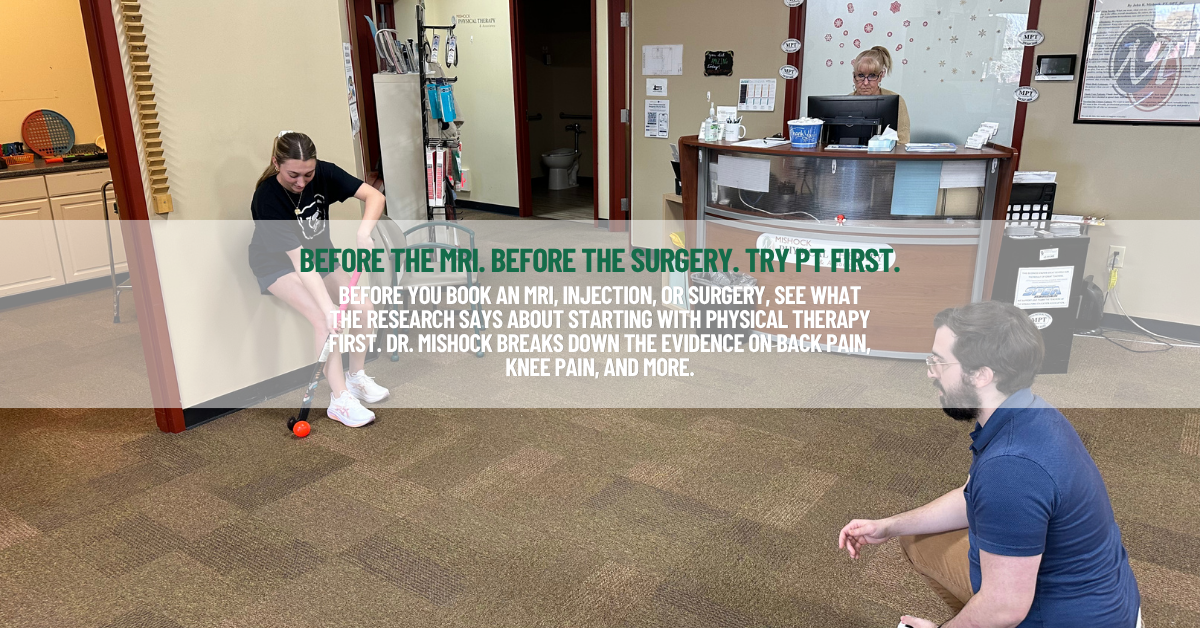

Before the MRI, Injection, or Surgery: Try Physical Therapy First
By Dr. John Mishock, PT, DPT, DC
When back, neck, shoulder, or knee pain develops, most people want one thing: to get better as quickly as possible. For years, the traditional healthcare pathway often looked something like this:
Pain → medication → X-ray or MRI → specialist → injection → physical therapy → possibly surgery. But for many common musculoskeletal problems, the evidence supports considering a different strategy:
Try physical therapy first.
That does not mean physical therapy is appropriate for every condition, nor does it mean that MRIs, medications, injections, or surgery are unnecessary. They can all be extremely valuable when used for the right patient at the right time. The key is starting with conservative, evidence-based treatment whenever it is medically appropriate.
TREAT THE PERSON, NOT JUST THE PAIN
An MRI can provide detailed information about anatomy, but structural abnormalities on imaging do not always correspond with pain or disability. Degenerative findings such as disc degeneration, bulging discs, and protrusions are frequently found in people without back pain, and their prevalence increases with age. (Brinjikji, AJNR Am J Neuroradiol, 2015) Medication can decrease pain, and an injection may temporarily reduce symptoms, but neither automatically restores strength, mobility, balance, endurance, or movement capacity. Physical therapy approaches the problem differently.
A physical therapist evaluates how the body moves, identifies weakness or mobility limitations, assesses joint and muscle function, and develops a plan designed to restore physical capacity. Treatment may include progressive strengthening, therapeutic exercise, mobility training, balance and neuromuscular training, education, manual therapy, and gradual return to normal activity. The goal is not simply to make something hurt less. The goal is to restore function.
LOW BACK PAIN IS A GREAT EXAMPLE
Low back pain is the leading cause of disability worldwide and affects people across virtually all ages and socioeconomic groups. (Hartvigsen, Lancet, 2018) For most people with low back pain, a specific serious structural cause such as fracture, malignancy, or infection cannot be identified. (Hartvigsen, Lancet, 2018)
Clinical guidelines recommend non-drug treatments, including exercise and other appropriate noninvasive therapies, as important components of care for many patients with low back pain. (Qaseem, Ann Intern Med, 2017) Research has also examined what happens when physical therapy occurs earlier in the healthcare process.
Patients with low back pain who saw a physical therapist as the first point of care had lower use of opioid prescriptions and several forms of downstream healthcare utilization compared with patients entering the system through other providers. (Frogner, Health Serv Res, 2018) This does not mean every MRI, injection, or specialist visit is unnecessary. It means we should ask whether conservative treatment can solve the problem before automatically progressing toward more expensive or invasive care.
PHYSICAL THERAPY VERSUS A KNEE INJECTION
One of the strongest examples comes from knee osteoarthritis. In a randomized clinical trial published in the New England Journal of Medicine, patients with knee osteoarthritis were assigned to either physical therapy or intra-articular glucocorticoid injections (Deyle, N Engl J Med, 2020).
At one year, the patients assigned to physical therapy had significantly less pain and functional disability than those assigned to corticosteroid injections. (Deyle, N Engl J Med, 2020) That does not mean injections never have a role. They do. But the study demonstrates that treating strength, mobility, movement, and physical function can produce meaningful long-term results. Major osteoarthritis guidelines strongly recommend exercise for people with knee and hip osteoarthritis and recognize physical therapy as an important component of care. (Kolasinski, Arthritis Care Res, 2020)
WHAT ABOUT OPIOIDS?
The potential impact of early rehabilitation becomes even more important when opioid medications are considered. A large study examined 88,985 opioid-naive patients with newly diagnosed low back, knee, neck, or shoulder pain. (Sun, JAMA Netw Open, 2018) Early physical therapy was associated with a significantly lower likelihood of subsequent opioid use across all four musculoskeletal conditions studied. (Sun, JAMA Netw Open, 2018) Among patients who did eventually use opioids, early physical therapy was also associated with lower amounts of opioid use for several of the conditions studied (Sun, JAMA Netw Open, 2018). This does not prove that physical therapy alone prevents opioid use, but it supports providing patients with effective non-drug options early in their care.
TRY PT FIRST DOES NOT MEAN PT ONLY
There are times when a patient should see a physician, undergo imaging, receive an injection, or have surgery. Significant trauma, suspected fracture, progressive neurological deficits, suspected cancer or infection, and symptoms suggesting cauda equina syndrome are examples of situations in which further medical evaluation and imaging may be appropriate. (Patel, J Am Coll Radiol, 2016)
A good physical therapist should recognize these situations. We evaluate, screen, and treat when appropriate. And when something falls outside our scope or is not progressing appropriately, we refer. That is what evidence-based healthcare should look like. “Try PT First” does not mean “PT Only.” It means beginning with a safe, conservative treatment when appropriate, measuring the patient’s response, and escalating care intelligently when necessary.
DON’T LET AN MRI DEFINE YOU
One of the mistakes we can make in healthcare is convincing people that their bodies are simply “worn out.”
An X-ray may show arthritis. An MRI may show a bulging disc. A tendon may show degenerative changes.
Those findings can be important, but they are not the entire clinical picture. Research has demonstrated substantial rates of disc degeneration, disc bulges, protrusions, and other degenerative spinal findings in people who have no pain at all. (Brinjikji, AJNR Am J Neuroradiol, 2015) That means an MRI finding must be interpreted together with the patient’s symptoms, physical examination, function, and medical history rather than viewed in isolation. (Brinjikji, AJNR Am J Neuroradiol, 2015) The human body also retains an extraordinary ability to adapt. Muscles can become stronger. Balance can improve. Mobility can improve. Endurance, movement, and confidence can improve. The goal should not necessarily be to create a perfect picture on an MRI. The goal is to create a better-functioning person.
ASK THIS QUESTION FIRST
If you develop back pain, neck pain, shoulder pain, knee pain, arthritis symptoms, or another muscle or joint problem, ask one simple question: “Would physical therapy be an appropriate first step?”
But if evidence-based rehabilitation can help you recover, improve function, and return to the activities you enjoy without requiring more invasive treatment, that is a tremendous win.
At Mishock Physical Therapy, our philosophy is simple: Treat the problem early. Restore movement. Build strength. Keep people active. Escalate care when it is medically necessary. When appropriate, start conservatively. Start actively. Try physical therapy first.
We can help!
Visit our website to read more physical therapy related articles, learn more about our treatment philosophy, our physical therapy staff, and our 5 convenient locations in Gilbertsville (610-327-2600), Skippack (610-584-1400), Phoenixville (610-933-3371), Boyertown (610- 845-5000), Limerick (484-948-2800) at www.mishockpt.com or request your appointment by clicking here.
Dr. Mishock is one of only a few clinicians with doctorate-level degrees in both physical therapy and chiropractic in the state of Pennsylvania. He has also authored two books; “Fundamental Training Principles: Essential Knowledge for Building the Elite Athlete”, “The Rubber Arm; Using Science to Increase Pitch Control, Improve Velocity, and Prevent Elbow and Shoulder Injury” both can be bought on Amazon or train2playsports.com.